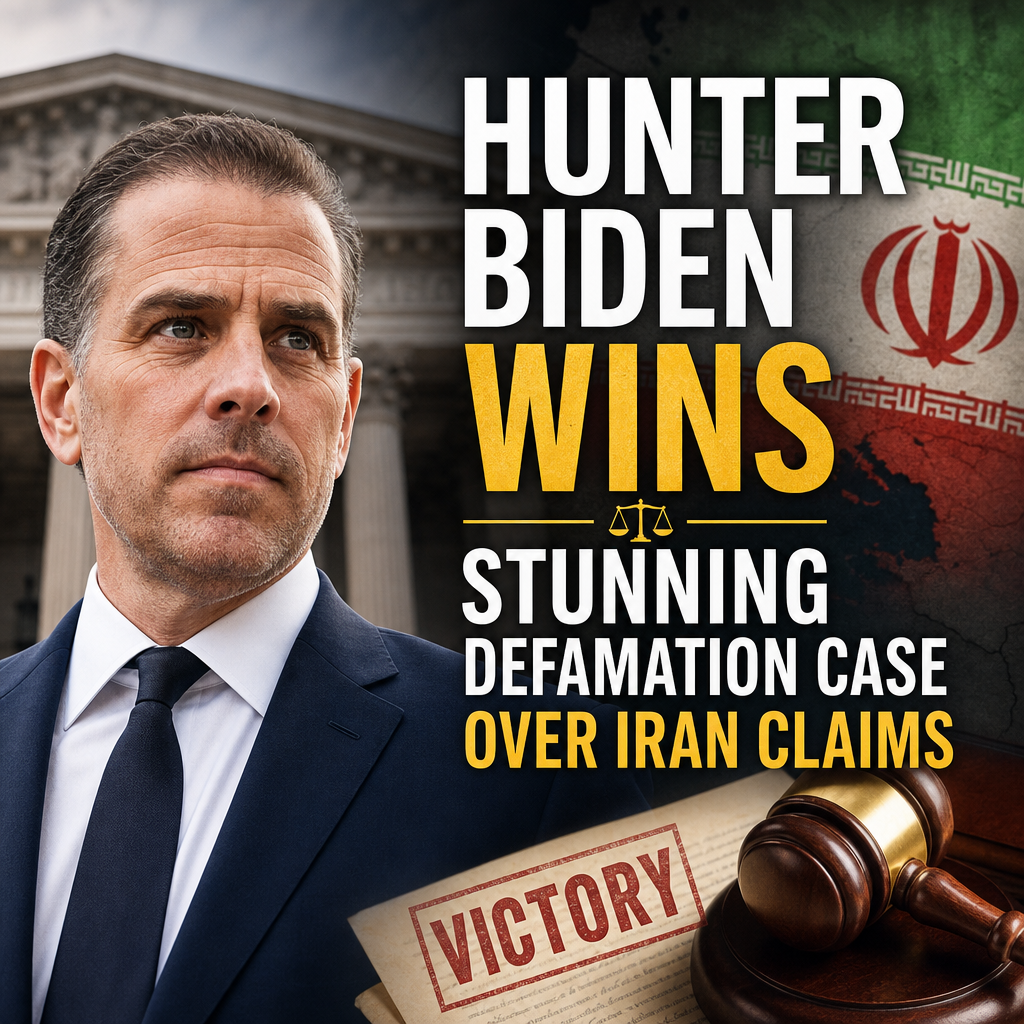
Hunter Biden Wins Stunning Defamation Case Over Iran Claims


Hunter Biden’s defamation win has become more than a courtroom result; it has reopened a wider argument about how far political claims can go before they become legally damaging.
A Delaware jury’s decision in favor of Biden over allegations tied to Iran was striking not only because of the verdict itself, but because of what it says about the modern information environment. In an era when political attacks travel quickly through television, social media, and partisan outlets, courts are increasingly asked to decide where sharp opinion ends and defamatory accusation begins.



What the case means beyond the verdict
At the center of the dispute was a set of claims portraying Hunter Biden as somehow connected to Iran in a way that his legal team argued was false and damaging. The jury agreed that the claims crossed a line. That matters because defamation cases involving public figures are notoriously difficult to win. Plaintiffs must usually show not just that a statement was false, but that it was made with actual malice — meaning the speaker knew it was false or acted with reckless disregard for the truth.
That high bar is one reason the verdict drew attention from legal observers and political commentators alike. It suggests that even in a climate where public skepticism runs high, there are still limits to how far unverified allegations can be pushed before they become legally risky.




But the outcome does not settle the broader political fight around Hunter Biden. If anything, it underscores how polarized the narrative already is. Supporters of the verdict see it as a straightforward correction: a reminder that accusations should be grounded in evidence. Critics, meanwhile, are more likely to view the case through a political lens, arguing that litigation over public commentary can become another battlefield in an already overheated culture war.
Why the media reaction matters
The response across international outlets shows just how differently the story can be framed.
Some coverage, including from RT, has emphasized the explosive nature of the claims and the symbolic victory for Biden. Other reporting, such as from Al Jazeera, tends to place the case in a broader context of U.S. political conflict, legal standards, and the Biden family’s long-running public scrutiny. Sky News-style coverage often focuses more on the procedural and human angle: what the jury decided, why it matters, and how it fits into a broader pattern of legal challenges surrounding the Biden name.
Those differing frames are important because they reveal the central tension in the story. Is this primarily a personal legal victory, a warning to media figures, or a minor chapter in a larger political drama? The answer depends partly on where the audience gets its news.
Hunter Biden defamation case and the politics of accusation
The case also arrives at a time when public discourse in the U.S. is especially vulnerable to rumor-driven narratives. Claims about foreign influence, family ties, and national security are among the most potent in politics because they can be hard to disprove quickly and easy to repeat.
That makes the Iran allegation especially sensitive. Even when a statement sounds speculative or rhetorical, it can still do reputational damage if repeated as fact. For someone like Hunter Biden, who has long been a target for political opponents, the effects are amplified. His name has become a shorthand in partisan debates about corruption, privilege, and presidential accountability. That context likely made the jury’s job both simpler and harder: simpler in the sense that the alleged harm was easy to understand, harder because the case sat inside a storm of preexisting opinions.
A fair reading of the case should acknowledge two truths at once:
– Public figures do face intense scrutiny, and criticism of the Biden family is not automatically defamatory.
– But scrutiny is not the same thing as making serious factual claims without solid evidence.
That distinction is increasingly blurred in online discourse, where outrage often travels faster than verification.
The legal and political ripple effects
The verdict may also encourage more caution among commentators and broadcasters. If anything, the case reinforces the notion that repeated allegations, especially about sensitive subjects like foreign ties or corruption, can carry legal consequences when they are not adequately substantiated.
Still, it would be a mistake to see the case as a cure for misinformation. Defamation law is a blunt instrument. It can punish certain falsehoods after the fact, but it cannot prevent the spread of rumors in real time. By the time a case reaches a jury, the disputed claim may already have circulated widely, shaping public opinion regardless of the eventual judgment.
That limitation helps explain why the reaction to the verdict has been so mixed. For some, it is proof that the system can still defend reputations against reckless accusation. For others, it is simply another flashpoint in a political era where nearly every legal dispute is interpreted through a partisan filter.
A verdict with limited but real significance
The most balanced conclusion is that Hunter Biden’s win is meaningful, but not transformative. It confirms that courts can still draw a line between protected speech and harmful falsehoods, even in a politically charged case. At the same time, it does not resolve the larger questions surrounding the Biden family’s public role, the ethics of political media, or the public’s appetite for sensational claims.
What the verdict really highlights is a deeper problem in modern politics: the ease with which accusation can be mistaken for evidence. In that sense, the case is less about one family than about a media culture that rewards speed, suspicion, and certainty before facts are fully tested.
That is why the ruling resonates beyond the courtroom. It is a reminder that in a democratic society, sharp criticism is essential — but so is the responsibility to separate commentary from claims that can seriously damage a person’s name.